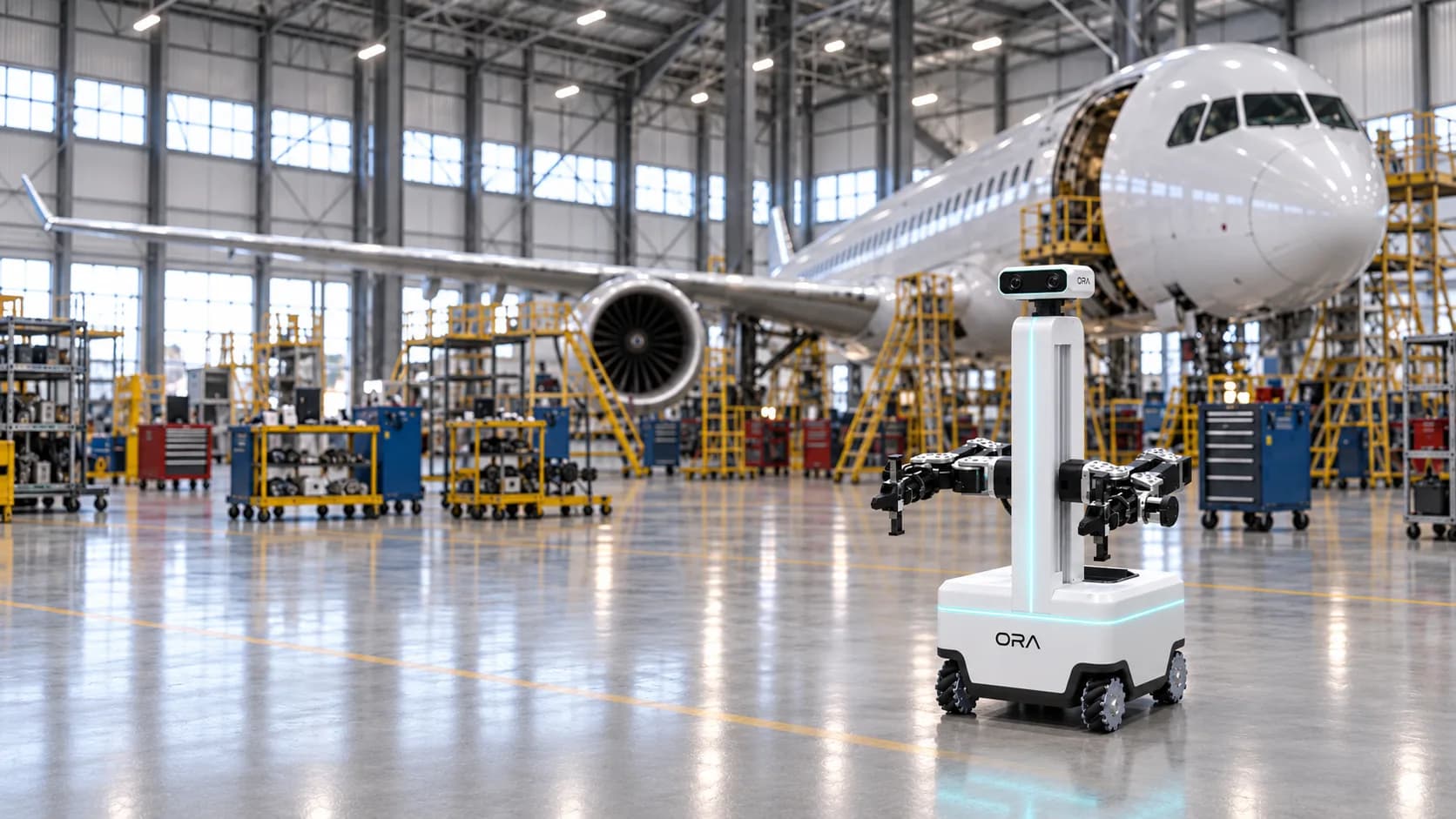
The robot that works from day one.
A wheeled two-arm base with onboard perception. Teleoperated by our operators from the first shift, autonomous task by task. No cage, no floor rail, no line redesign.
Three parts, one machine.
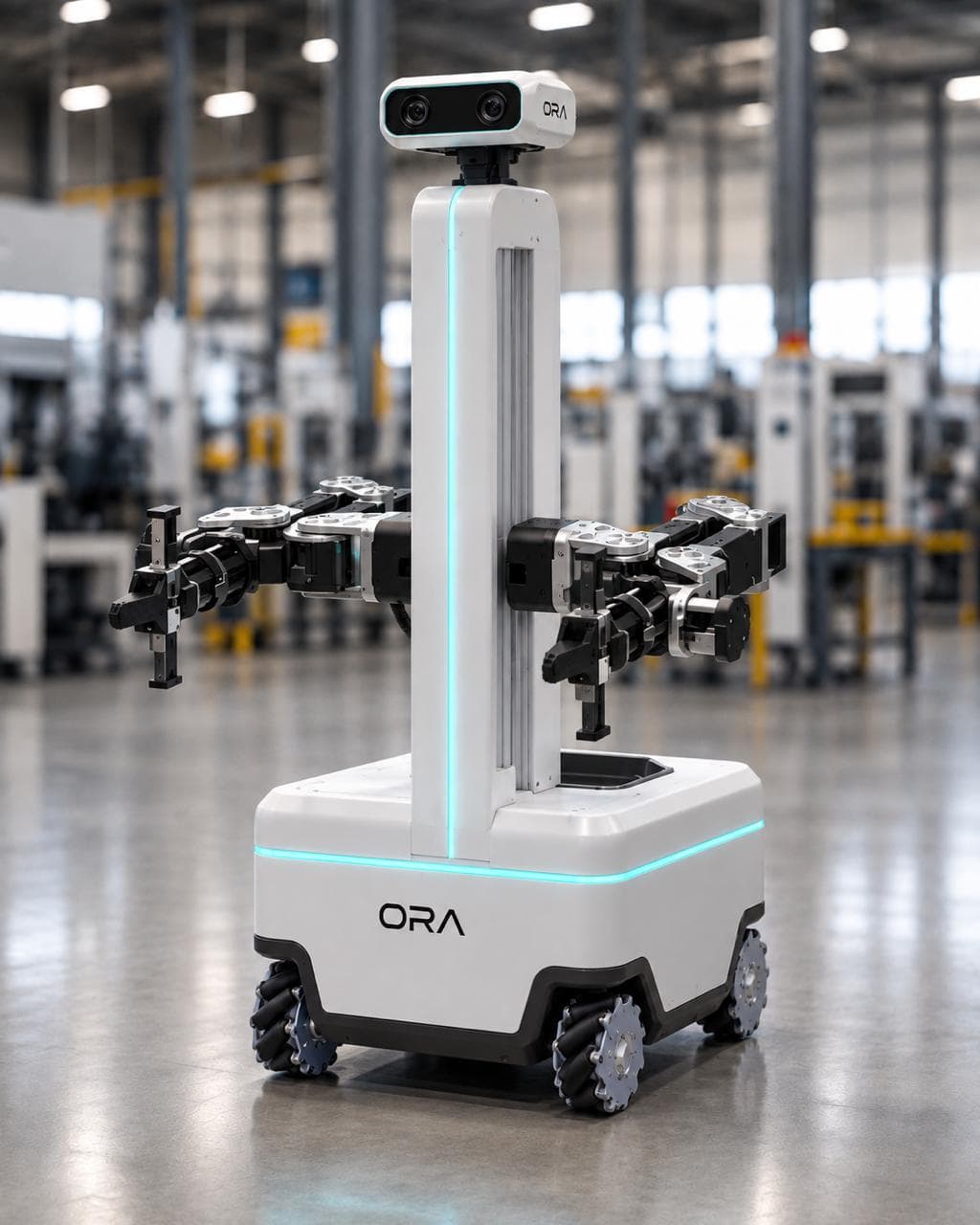
Rather than a complex, fragile humanoid, a wheeled platform with two arms. Bimanuality without the cost, fragility and safety constraints of legs.
Sensor head
A 360° camera for navigation and the overall view, plus depth sensing. What the robot perceives is exactly what the remote operator sees.
Two arms
Two arms and their grippers, with a camera on each wrist. One arm picks and places; two arms steady a part while it is worked. Most real tasks are bimanual.
Wheeled base
Stable by design. No balance to maintain, no fall possible, no new risk on a site where people move. That is what makes installation fast instead of a project.
Reduced speeds near people, emergency stop, obstacle detection and exclusion zones defined with the site. On loss of link the robot stops, it never continues a motion on its own.
One machine, many missions.
The robot does not change hardware to change task. Here is some of what it does, the list is open.
Supply
Bring parts, tooling and consumables to the workstation.
Prepare
Assemble kits, tidy the station, gather what an operator needs before they ask.
Transport
Move bins, boxes and trays from one zone to another.
Inspect
Walk a zone, check visually, detect what should not be there.
Record
Read an instrument, verify a presence, count, document with a timestamped photo.
Assist remotely
Let an expert see and act on a site where they are not present.
Deployment, teleoperation, autonomy.
The robot does not wait to be autonomous before going into the field. It goes first, remotely piloted by our operators, and it becomes autonomous because it has been there.
Deployment
The robot is installed on site, in the existing premises, with no facility changes.
Teleoperation
A trained operator pilots it remotely. The task is done correctly from day one.
Autonomy
Tasks move to autonomy one by one. The operator shifts from piloting to supervision, stepping in only on edge cases.
Robot as a service.
One monthly fee. No capital expenditure, no integration project, no in-house robotics team. We install, we operate, we maintain.
Final pricing depends on mission scope, hours of operation and fleet size. Scoped with you before any pilot.
Anywhere there are trips, objects and checks.
Moving among people, grasping, observing, reporting: this foundation belongs to no single sector. We start with industry and logistics, where needs are densest.
Industry
Assembly lines and workshops where operators lose hours walking to fetch what they need.
Time at the workstation
Technicians stay on the value-adding gesture instead of crossing the shop floor for a missing part.
Logistics & warehouses
High-traffic sites with constant transfers between zones and repetitive checks.
Fewer empty trips
Transfers run continuously without a human pushing a trolley from one end of the building to the other.
Health & hospitals
Large buildings where clinical staff spend a share of every shift transporting things.
Time returned to care
Every hour a nurse does not spend pushing a cart between departments is an hour available for patients.
Retail
Stores where shelf availability drives revenue but staff time is scarce.
Shelves that stay full
Gaps are detected and refilled continuously instead of once a day when someone finally walks the aisle.
Offices & labs
Sites with recurring internal flows and readings nobody wants to do manually.
Routine off the payroll
Repetitive rounds and readings run on schedule, documented with a timestamped record every time.
Your sector is not listed? If the work involves moving between points, handling objects and reporting what was found, the robot applies. Tell us the task and we will tell you whether it is in reach today.
The robot learns by working.
While it is piloted, the robot records what it sees, what it does and how the operator goes about it. Those gestures, captured on real sites, train the models that make it autonomous.
We collect on site
The data that matters is field data, with its lighting variations, its misplaced parts and its surprises. That is what we capture, every working hour.
We train our own models
A dexterous VLA model turns what the robot sees into precise gestures, paired with a reasoning model that plans the steps behind a natural-language instruction. Together, that is what lets a robot do a task it was not programmed for.
The robot improves
Each time an operator takes back control, the model learns where it went wrong. Mastered tasks switch to autonomy; the rest stay piloted.
Bring a robot to your site.
We install a robot on a real task, with an operator, for a scoped pilot. The best way to judge is to see it work at your site.